💡 Heads Up: This article is approximately 1,800 words and designed as a comprehensive educational guide. You may find it helpful to bookmark this page and return to it in stages which will make it easier to understand and integrate into your health routine.
Modern juicing trends often focus on green vegetables and low-sugar blends. Yet among all of the fruits used in juices, pomegranate stands apart.
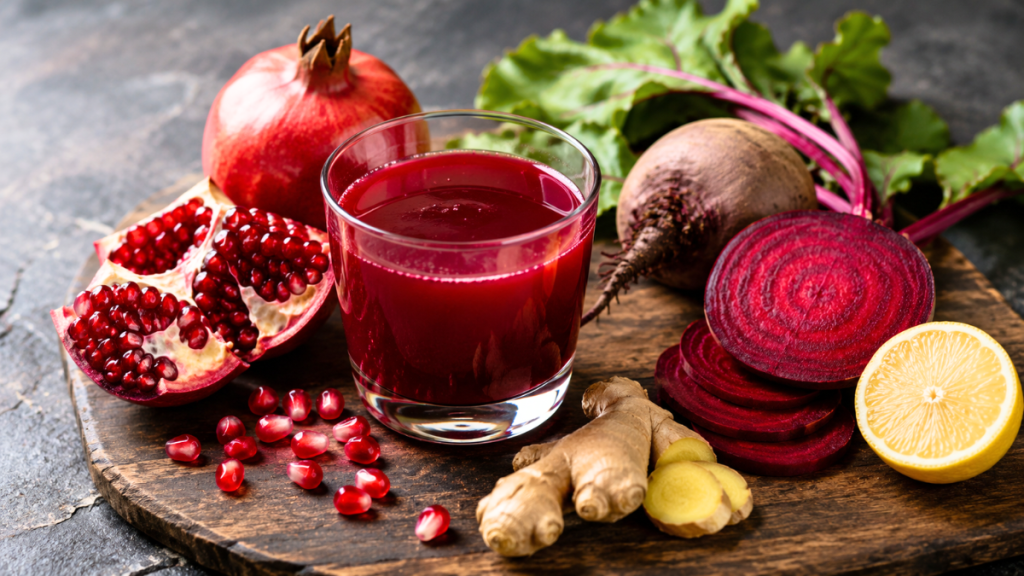
It is one of the richest natural sources of polyphenols known in the plant world. Its deep ruby colour signals a concentration of antioxidant compounds that interact directly with vascular tissue — particularly the delicate inner lining of blood vessels — while also influencing inflammatory signalling and helping protect cells from oxidative stress.
Unlike lighter fruit juices, pomegranate juice is not primarily used for hydration or sweetness. It is used strategically — for its density. Across cultures, it has been associated with:
- Blood circulation
- Vitality
- Blood nourishment
- Longevity
Modern research now connects these traditional associations with measurable physiological effects. Studies suggest pomegranate juice may help support healthy blood pressure, maintain balanced cholesterol levels, reduce oxidative stress, regulate blood sugar and modulate inflammatory signalling — all of which are key cardiovascular risk factors.
Within a structured juice cleanse, pomegranate is rarely used as the primary bulk ingredient. Unlike celery, cucumber, or leafy greens — which typically form the base of a juice — pomegranate is added in smaller quantities as a concentrated functional component.
This article explores the phytonutrients behind those effects and how it fits intelligently into modern juicing protocols.
Table of Contents
The Key Phytonutrients That Define Pomegranate
Pomegranate Juice and Vascular Health
Pomegranate Juice and Oxidative Stress
Pomegranate Juice and Inflammation Balance
Pomegranate Juice and Blood Sugar Regulation
A Historical Note: Pomegranate in Antiquity
When Should You Be Cautious with Pomegranate Juice?
The Key Phytonutrients That Define Pomegranate
Pomegranate juice is not simply “antioxidant-rich”. It contains specific, highly active polyphenols that distinguish it from most other fruits.
Punicalagins
Punicalagins are large, water-soluble polyphenols that are particularly concentrated in pomegranate and largely absent from most other common fruits. They are a defining compound of pomegranate juice and account for much of its unusually high antioxidant capacity. These compounds:
- Neutralise free radicals: These unstable molecules can damage cells and accelerate ageing when left unchecked.
- Support endothelial integrity: Helping maintain the health of the thin inner lining of blood vessels, allowing arteries to expand and contract efficiently.
- Help preserve nitric oxide availability: This tells blood vessels to relax, enabling a healthier blood pressure and circulation.
Ellagic Acid
Ellagic acid is produced when punicalagins are broken down during digestion and metabolism – once your body processes pomegranate’s primary polyphenols, ellagic acid becomes one of the active compounds circulating in the bloodstream. It has been studied for:
- Anti-inflammatory signalling: Helping down-regulate certain pro-inflammatory chemical messengers (cytokines) that drive chronic inflammatory responses.
- Cellular protection: Supporting the body’s natural defence systems that protect cells from oxidative damage.
- Oxidative stress reduction: Helping neutralise excess free radicals before they damage lipids, proteins, and vascular tissue.
Free radicals are a normal by-product of metabolism, but when they accumulate in excess they can contribute to arterial damage, cellular ageing, and inflammatory imbalance. Ellagic acid helps counter these processes and supports protection against oxidative stress.
Anthocyanins
Anthocyanins are the pigments that give pomegranate its deep red colour. Like other deeply coloured fruits, the intensity of colour reflects a concentration of protective plant compounds. These compounds are associated with:
- Vascular resilience: Supporting the flexibility and strength of blood vessels.
- Capillary integrity: Helping maintain the stability of small blood vessels that deliver oxygen and nutrients to tissues.
- Oxidative balance: Contributing to the body’s antioxidant defence network.
They are also found in deeply coloured fruits such as blueberries, blackberries and raspberries, but in pomegranate they occur alongside punicalagins and ellagic acid, creating a particularly dense antioxidant profile. For a broader understanding of how plant compounds influence detoxification and inflammation pathways, see our detailed guide to phytonutrients.
Pomegranate Juice and Vascular Health
One of the most studied effects of pomegranate juice is its influence on the endothelium — the thin inner lining of blood vessels. Healthy endothelial function allows arteries to:
- Dilate appropriately
- Maintain elasticity
- Regulate blood flow efficiently
Pomegranate polyphenols appear to support this process by helping preserve nitric oxide — a signalling molecule that tells blood vessels to relax. Nitric oxide is naturally produced in the body, but it can be degraded by oxidative stress. By reducing oxidative damage, pomegranate helps protect nitric oxide availability.
Through this mechanism, research suggests regular consumption of pomegranate juice may:
- Reduce arterial stiffness
- Improve endothelial responsiveness
- Support healthy circulation
This pathway is distinct from — but complementary to — nitrate-rich vegetables such as beetroot juice. Beetroot works by increasing nitric oxide production through dietary nitrates, whereas pomegranate helps protect nitric oxide once it has been produced.
For this reason, the two ingredients are often combined in circulation-focused juicing recipes.

Pomegranate Juice and Oxidative Stress
Oxidative stress occurs when the production of free radicals exceeds the body’s antioxidant defence systems. When this imbalance persists, it can contribute to cellular damage, vascular dysfunction, and inflammatory signalling.
Pomegranate juice has a high antioxidant capacity due to its dense polyphenol content. Studies suggest it may help:
- Protect LDL cholesterol from oxidation: When LDL particles become oxidised, they are more likely to contribute to arterial plaque formation and vascular inflammation. By helping prevent LDL oxidation, pomegranate may support long-term arterial health.
- Support cellular antioxidant enzymes: Pomegranate polyphenols may stimulate the body’s own internal defence systems — such as superoxide dismutase and glutathione-related pathways — which help neutralise excess free radicals at a cellular level.
- Reduce oxidative burden in vascular tissue: By lowering oxidative stress within blood vessel walls, pomegranate may help preserve endothelial function and maintain arterial flexibility.
Protection against LDL oxidation is particularly relevant to long-term cardiovascular integrity, as oxidative damage to lipids is considered an early step in the development of atherosclerosis — a condition characterised by the progressive narrowing and stiffening of arteries.
Pomegranate Juice and Inflammation Balance
Chronic low-grade inflammation contributes to vascular dysfunction and metabolic disturbances such as impaired insulin sensitivity, unstable blood sugar regulation and unhealthy cholesterol and fat levels in the bloodstream.
Pomegranate polyphenols have been shown to influence inflammatory markers, potentially helping to:
- Regulate cytokine signalling
- Reduce oxidative-driven inflammation
- Support antioxidant enzyme activity
When combined with other anti-inflammatory ingredients — such as fresh ginger, pineapple (rich in bromelain), spinach, or celery juice — the effects may be complementary within targeted juice recipes.
Pomegranate Juice and Blood Sugar Regulation
Pomegranate juice contains natural sugars, but its polyphenols may influence glucose metabolism. Some studies indicate that polyphenol-rich fruit extracts can:
- Improve insulin sensitivity markers
- Reduce oxidative stress linked to metabolic dysfunction
- Support balanced inflammatory signalling
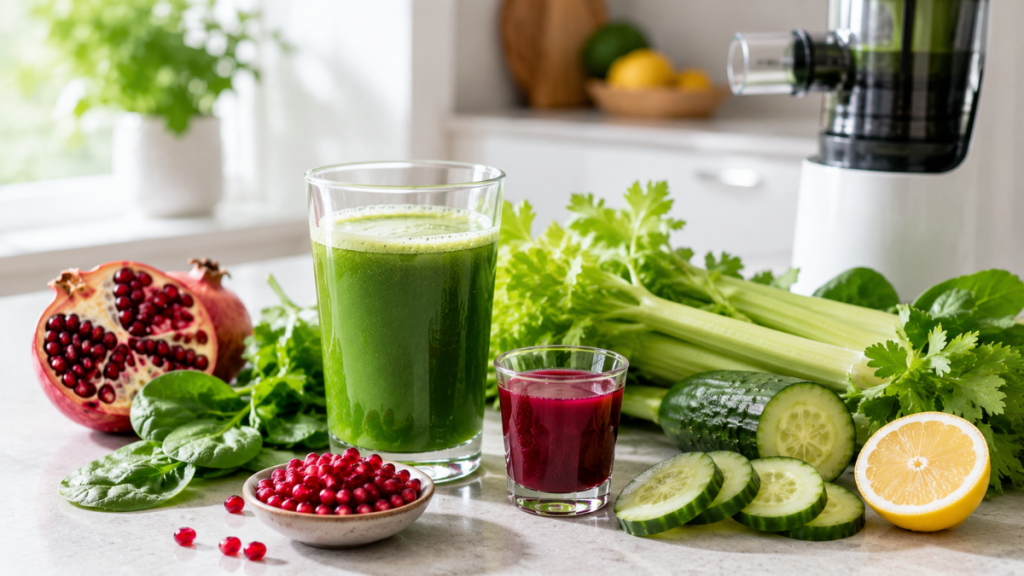
However, because it contains natural fructose, pomegranate juice should be used thoughtfully if your goal is to create juices to regulate blood sugar or improve insulin sensitivity. While its polyphenols may offer metabolic benefits, the natural sugar content means portion size and overall juice composition matter.
For extracting pomegranate juice, a masticating (slow) juicer is generally more effective than a centrifugal machine. Its crushing mechanism presses the seeds more thoroughly, producing a higher juice yield and leaving drier pulp. If pomegranate is a regular part of your routine, choosing the best juicer for your needs becomes important.
A Historical Note: Pomegranate in Antiquity
Long before it was studied for its phytonutrients and active compounds, pomegranate held powerful symbolic meaning across ancient civilisations. Its abundance of tightly packed seeds made it a natural emblem of fertility, regeneration and life itself.
In Ancient Persia, Greece, and Egypt, the fruit was associated with:
- Fertility and reproduction
- The feminine principle and the womb
- Cycles of death and rebirth
In Greek mythology, the story of Persephone links pomegranate to seasonal renewal and the rhythms of nature. In Egypt, the fruit was placed in tombs as a symbol of regeneration in the afterlife. Across the Mediterranean, its deep red juice was often likened to blood — reinforcing its association with vitality and continuity of life.
It was commonly eaten fresh or pressed, suggesting that the use of concentrated plant liquids long predates modern juicing culture — even if the language used to describe their effects was symbolic rather than biochemical.
For a broader exploration of how ancient civilisations used therapeutic plant liquids, see our guide to juicing in antiquity.
When Should You Be Cautious with Pomegranate Juice?
Pomegranate juice is nutrient-dense, but caution is appropriate in certain contexts.
- It contains natural sugars
- It may interact with blood pressure medications
- It may interact with certain cholesterol-lowering medications
Individuals taking medication should consult a qualified professional before regular therapeutic use.
Read Next
If you’re wanting to expand your knowledge and understanding of juicing further, you may also find the following articles helpful:
➡️ Juice Cleanse: How a structured body cleanse supports detoxification, circulation, and metabolic reset.
➡️ 3-Day Juice Cleanse: A focused guide to fasting – preparation, execution, and reintroduction.
➡️ Juicing to Lower Blood Sugar: Strategies designed to support insulin sensitivity and regulate glucose levels.
➡️ Best Juicer: A comparison between masticating (slow) juicers and centrifugal juicers..
➡️ Beetroot juice, Carrot juice, Lemon juice, and Ginger juice: Explore how these ingredients complement pomegranate in supporting circulation, digestion, and metabolic resilience.

FAQs About Pomegranate Juice
Is pomegranate juice good for heart health?
Pomegranate juice is rich in polyphenols that support endothelial function and help reduce oxidative stress. Some studies suggest it may support healthy blood pressure and vascular function.
Is pomegranate juice high in sugar?
Yes, pomegranate juice contains natural sugars. For this reason, it is best used in moderate amounts or diluted with vegetable juices during structured cleansing protocols.
Does pomegranate juice reduce inflammation?
Pomegranate contains powerful antioxidants such as punicalagins and ellagic acid, which have been shown to help regulate inflammatory signalling and oxidative stress.
Can pomegranate juice help circulation?
Research suggests pomegranate juice may help maintain healthy blood vessel function and nitric oxide availability, supporting circulation.
Is pomegranate juice safe during a juice cleanse?
In small quantities, it can complement vegetable-based juices by providing antioxidant support. However, because of its sugar content, it is typically used strategically rather than as a base juice.
Can pomegranate juice interact with medication?
Pomegranate may influence certain medications, particularly blood pressure or cholesterol drugs. Individuals taking medication should consult a healthcare professional before regular use.
Disclaimer: This content is for informational and educational purposes only and is not intended to diagnose, treat or cure any disease. It is not a substitute for professional medical advice. Please consult a qualified healthcare professional before making significant changes to your health regimen. This article may contain affiliate links. As an Amazon Associate, Nature Heal may earn from qualifying purchases.