💡 Heads Up: This article is approximately 1,600 words and designed as a comprehensive educational guide. You may find it helpful to bookmark this page and return to it in stages which will make it easier to understand and integrate into your health routine.
If you plan to get into juicing, the juicer you choose matters more than you realise. The best juicer for a juice cleanse is not simply the most expensive one — it’s the one that preserves nutrients, extracts efficiently from greens, and produces juice your body can absorb easily.
In this guide, we compare slow (masticating), cold press and centrifugal juicers, explain oxidation and nutrient retention, and recommend the best juicer options for different budgets and goals.
If you’re new to body cleansing, you may wish to read our guide to the juice fasting first, which explains how juicing fits into a gut reset and liver detox sequence.
Table of Contents
What Is the Best Type of Juicer for a Juice Cleanse?
Slow Juicer vs Masticating Juicer: Your Preferred Choice
Centrifugal Juicer: Pros and Limitations
Cold Press Juicer vs Centrifugal Juicer: Key Differences
Best Juicers in the UK, by Budget
Frequently Asked Questions About Juicers
What Is the Best Type of Juicer for a Juice Cleanse?
When selecting the best juicer for juice detox, your primary consideration is going to be nutrient preservation and extraction efficiency. During a structured juice fast, for example, the goal is to:
- Maximise phytonutrient delivery
- Reduce oxidation
- Extract deeply from leafy greens
- Preserve micronutrients
Juicing is metabolically different from blending smoothies. When you juice, you remove the fibre and significantly reduce the digestive workload. This allows the body to redirect energy away from heavy digestion and toward internal processes of repair and detoxification.
When the body is given the right conditions — rest, hydration, and Internal Hygiene — it naturally begins to function more efficiently. Many people notice improved energy, mental clarity, and overall vitality during a properly structured cleanse.
This is why choosing the best juicer is not simply an impulse purchase. The quality of extraction, oxidation levels, and green vegetable performance all influence how effective your cleanse will be. A good juicer is more than just a kitchen appliance.
The three main types are:
- Masticating juicer (slow juicer / cold press juicer)
- Centrifugal juicer
- Manual or specialty presses
For those using leafy greens or fibrous vegetables regularly, a masticating juicer can significantly improve extraction quality while preserving delicate nutrients. If celery plays a central role in your juices — particularly for liver or blood sugar support — a slow juicer (also called a masticating juicer) is generally the better option. The same applies to mineral-rich greens such as kale and spinach, and to denser vegetables like carrot and beetroot, which form the backbone of many structured juicing recipes. These ingredients benefit from steady pressure extraction, something slower auger-based machines are designed to deliver.
This becomes particularly relevant in structured approaches focused on blood sugar balance, where green and bitter ingredients form the foundation of many juice combinations. Efficient extraction simply ensures you get the most from those ingredients.
Slow Juicer vs Masticating Juicer: Your Preferred Choice
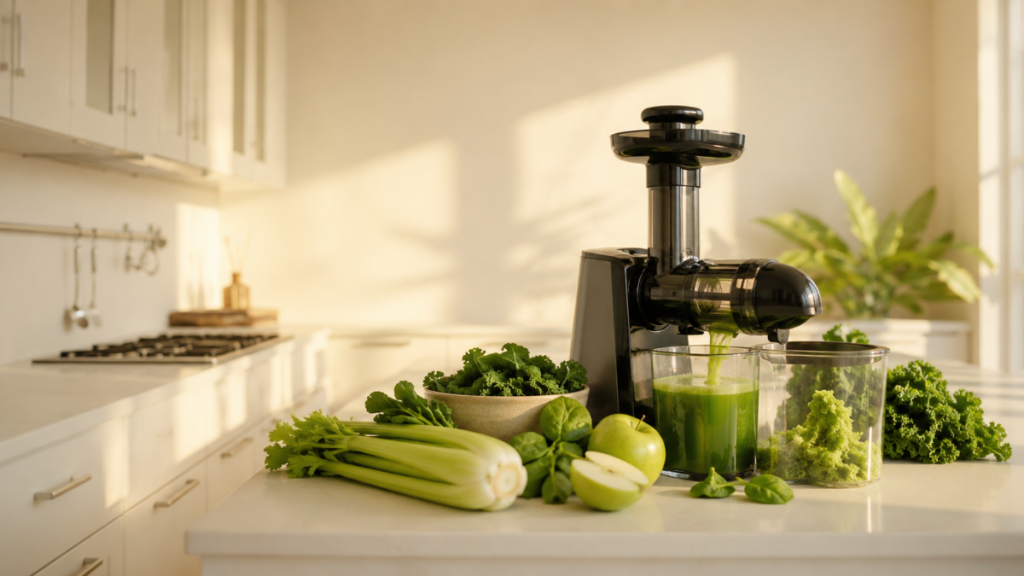
A masticating juicer, often called a slow juicer or cold press juicer, uses an auger to crush and press produce slowly at low RPM (typically 40–100 revolutions per minute).
How a Slow Juicer Works
Instead of using spinning blades, the auger in masticating juicers:
- Crushes produce
- Squeezes juice through a fine mesh
- Separates pulp efficiently
- Minimises air incorporation
This low-speed mechanism reduces heat generation and oxidation.

Benefits of a Slow Juicer
Juicing — particularly within a structured cleanse or juice fast — places emphasis on phytonutrient density — bioactive plant compounds. As these compounds are sensitive to oxidation, the method of extraction matters. Slow juicers minimise heat and air exposure, resulting in:
- Higher nutrient preservation
- More efficient green extraction
- Greater yield from fibrous produce
- Longer shelf life (24–48 hours refrigerated)
- Quieter, lower-speed operation
Centrifugal Juicer: Pros and Limitations
A centrifugal juicer operates at very high speeds (typically 6,000–14,000 RPM), using a spinning blade and mesh basket to separate juice from pulp. This rapid motion introduces more air into the juice and can generate mild heat through friction, which can:
- Reduce vitamin C stability
- Gradually affect sensitive phytonutrients
- Shorten the freshness window of the juice
That said, these effects are not dramatic when juice is consumed immediately. Detox drinks made with a centrifugal machine still provides meaningful nutritional value.
Advantages of Centrifugal Juicers
- Faster juicing
- Typically lower cost
- Widely available in UK retailers
- Simple operation for beginners
Limitations
- Lower yield from leafy greens
- Slightly shorter shelf life
- Less efficient extraction of fibrous vegetables
Cold Press Juicer vs Centrifugal Juicer: Key Differences
By this point we’ve looked at how each type works. To make the distinctions clearer, here is a side-by-side comparison:
| Feature | Masticating | Centrifugal |
| Nutrient Retention | Higher | Moderate |
| Oxidation | Low | Higher |
| Shelf Life | 24–48 hours | 12–24 hours |
| Leafy Greens | Excellent | Weak |
| Noise | Quiet | Loud |
| Speed | Slower | Fast |
| Price | Higher | Lower |
| Cleaning | Slightly longer | Faster |
The differences largely come down to extraction method and purpose. Cold press (masticating) juicers prioritise slower, lower-oxidation extraction, while centrifugal models prioritise speed and convenience.
If your focus is detox or therapeutic cleansing, a masticating juicer is typically more appropriate; if speed and affordability are your priorities, a centrifugal machine may be sufficient.
Best Juicers in the UK, by Budget
Juicer prices in the UK vary significantly depending on extraction method, build quality, and brand positioning. Below is a practical breakdown of what you can expect at different price tiers — and how each level aligns with your needs.
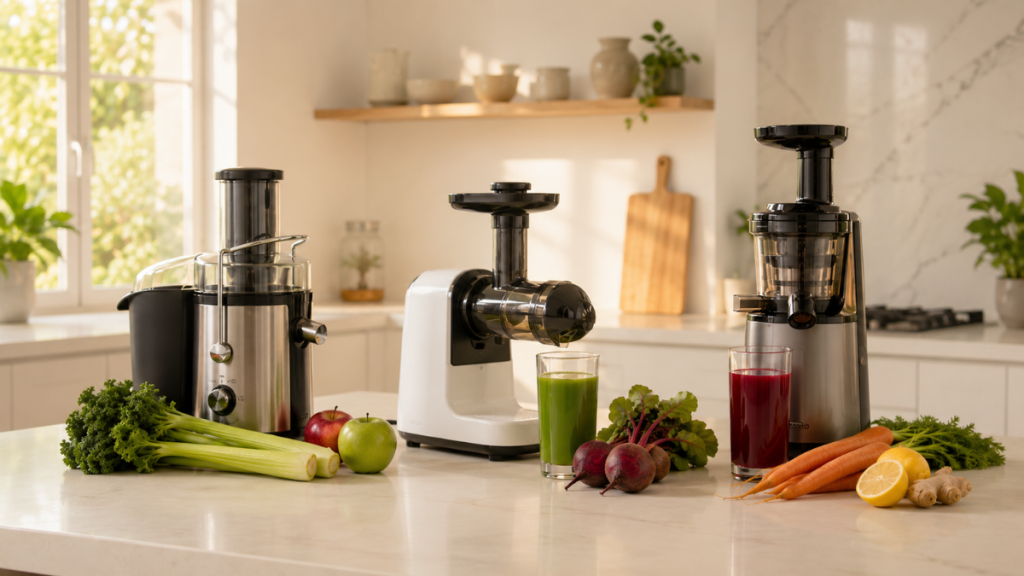
Best Budget Juicer, £60–£120
At this level, most machines are centrifugal models designed for speed and accessibility. They are widely available in UK retailers and suitable for occasional use:
- Ninja juicer
- Nutribullet juicer
- Philips centrifugal juicer
These machines prioritise convenience and affordability over maximum extraction efficiency.
Best Mid-Range Juicer, £150 – £300
In this tier, you’ll begin to see entry-level cold press (masticating) machines alongside higher-quality centrifugal models. Extraction improves noticeably, particularly with leafy greens and fibrous vegetables.
Common options in the UK market include:
- Nutribullet Slow Juicer
- Ninja Cold Press Juicer
- Panasonic Slow Juicer
- H.Koenig Cold Press models
At this level, you’re paying for slower RPM extraction, improved yield, and greater durability without moving into premium pricing.
Best Premium Cold Press Juicer, £400–£1,200+
Premium machines are typically full masticating or twin-gear cold press models built for high extraction efficiency and long-term use.
Well-known brands in this category include:
- Omega juicer
- Kuvings juicer
- Angel juicer
These machines are designed to:
- Maximise juice yield
- Preserve nutrients more effectively
- Handle celery and leafy greens exceptionally well
- Support frequent or long-term cleansing protocols
If you’re just getting started with juicing and budget is a priority, a well-reviewed centrifugal machine could be sufficient. If you plan to commit to regular juicing or structured fasting protocols as part of or even follow a body cleansing and detoxification programme, investing in a mid-range or premium slow juicer will provide better extraction performance and long-term value, investing in a mid-range or premium slow juicer will provide better extraction performance and long-term value.
Read next:
➡️ Juice Detox: Understand the full structured approach behind therapeutic juicing
➡️ 3-Day Juice Fast: Detailed guidelines to help you with your fast
➡️ Juicing Recipes: Powerful combinations targeting all aspects of health
➡️ Phytonutrients in Fresh Juice: How bioactive plant compounds support your body
➡️ Juicing for Blood Sugar Balance: Using greens and bitter vegetables strategically
➡️ Celery, Beetroot, Carrot, Ginger & Lemon Juice: The core ingredients behind effective juice formulae

Frequently Asked Questions About Juicers
Is a slow juicer better than a centrifugal juicer?
It depends on your purpose. Slow (masticating) juicers generally provide better extraction and stability. If speed, convenience and budget are your priorities, a centrifugal machine can still be suitable.
What is a masticating juicer?
A masticating juicer — often called a slow or cold press juicer — uses a low-speed auger to crush and press produce rather than using spinning blades. This slower extraction method reduces air incorporation and heat buildup.
Can centrifugal juicers handle hard or fibrous vegetables?
Yes, centrifugal machines can process firm produce such as carrots, beetroot and apples effectively. However, when working with fibrous greens or denser root-based blends, slow juicers typically achieve better yield and less pulp waste.
Do slow juicers preserve more nutrients?
Slow juicers operate at lower RPM, which reduces heat and oxygen exposure. While both machine types produce nutritious juice, slower extraction may help maintain vitamin stability and phytonutrient integrity for longer.
Is a cold press juicer the same as a slow juicer?
In most home appliances, yes. “Cold press” and “slow juicer” are commonly used interchangeably to describe masticating machines that extract juice at low speeds.
How long does fresh juice last in the fridge?
Juice made with a slow juicer can typically be stored for up to 24–48 hours in an airtight container under refrigeration. Centrifugal juice may begin separating sooner and is best consumed within 12–24 hours.
Is a slow juicer worth the investment for a cleanse?
If you plan to undertake repeated cleanses or rely heavily on leafy greens and fibrous vegetables, a slow juicer can offer better long-term value through improved extraction and durability. For occasional or short-term use, a centrifugal model may be sufficient.
Disclaimer: This content is for informational and educational purposes only and is not intended to diagnose, treat or cure any disease. It is not a substitute for professional medical advice. Please consult a qualified healthcare professional before making significant changes to your health regimen. This article may contain affiliate links. As an Amazon Associate, Nature Heal may earn from qualifying purchases.