💡 Heads Up: This article is approximately 1,600 words and designed as a comprehensive educational guide. You may find it helpful to bookmark this page and return to it in stages to better understand how ginger juice fits into your health routine.
Highly valued within a structured juice cleanse, ginger juice is one of the most physiologically active plant extracts used in therapeutic nutrition. Unlike nitrate-rich beetroot juice or electrolyte-focused celery juice, ginger works primarily by stimulating digestion, supporting blood circulation and helping regulate inflammatory processes.
Ginger activates digestive reflexes that increase gastric juice secretion — including stomach acid and digestive enzymes — while also encouraging pancreatic enzyme release and bile flow. At the same time, it supports healthy blood flow by promoting blood vessel relaxation and improving peripheral circulation.
These actions are achieved through compounds such as gingerols and shogaols which help regulate inflammatory signalling, support insulin sensitivity and improve how the body processes and utilises energy.
For these reasons, ginger juice is commonly used in juice recipes to support digestion, metabolic balance and circulatory function — particularly during periods of dietary reset or reduced caloric intake.
Table of Contents
Ginger Juice Phytonutrients and Bioactive Compounds
Ginger Juice and Digestive Enzyme Stimulation
Ginger Juice and Healthy Blood Circulation
Ginger Juice and Inflammation Modulation
Ginger Juice and Blood Sugar Regulation
Ginger Juice in a Structured Body Cleanse
A Historical Note: Ginger in Traditional Medicine
When Should You Be Cautious with Ginger Juice?
Ginger Juice Phytonutrients and Bioactive Compounds
Ginger’s physiological effects are driven by a class of bioactive compounds known as phenolic ketones and volatile oils. The most studied of these include gingerols, shogaols, and zingerone.
💡For a deeper understanding of how plant compounds influence human physiology, check out our guide on phytonutrients.
Gingerols
Gingerols are the primary active compounds in fresh ginger. These molecules:
- Regulate inflammatory enzymes such as COX-2
- Influence prostaglandin synthesis
- Exhibit antioxidant properties
- Support insulin sensitivity and healthy glucose uptake through improved cellular signalling
Gingerols are responsible for ginger’s characteristic pungency and much of its digestive-stimulating activity.
Shogaols
Shogaols are formed when ginger is dried or gently heated. They are structurally similar to gingerols but often demonstrate stronger anti-inflammatory activity in experimental models.
Shogaols contribute to:
- Reduced oxidative stress
- Inflammation pathway regulation
- Enhanced antioxidant defence
Zingerone
Zingerone is a less pungent compound that forms during heating. It exhibits mild antioxidant activity and contributes to ginger’s digestive-soothing properties.
Volatile Oils
Ginger also contains aromatic essential oils that:
- Stimulate digestive reflexes
- Contribute to antimicrobial effects
- Influence gut motility

Ginger Juice and Digestive Enzyme Stimulation
Ginger’s most immediate effect is on digestion. Bitter and pungent compounds activate receptors on the tongue which signals the stomach, pancreas and liver to prepare for incoming food.
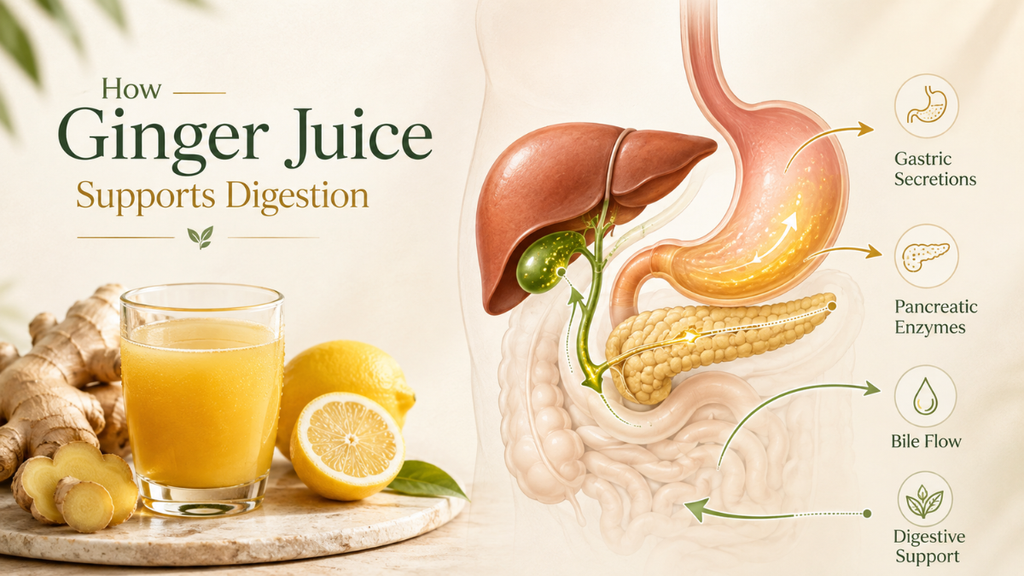
Research demonstrates that ginger can increase secretion of:
- Gastric acid
- Pancreatic amylase (carbohydrate digestion)
- Pancreatic lipase (fat digestion)
- Trypsin and chymotrypsin (protein digestion)
- Bile flow from the liver and gallbladder
This digestive activation is particularly valuable during a juice detox, where effective digestion helps the body adapt more smoothly to reduced intake. This coordinated response improves:
- Breakdown of fats and proteins
- Reduction in bloating
- Gastric emptying efficiency
- Nutrient absorption
For this reason, ginger juice is often consumed 15–20 minutes before meals to prime digestion. It may also be used after meals to reduce nausea or heaviness.
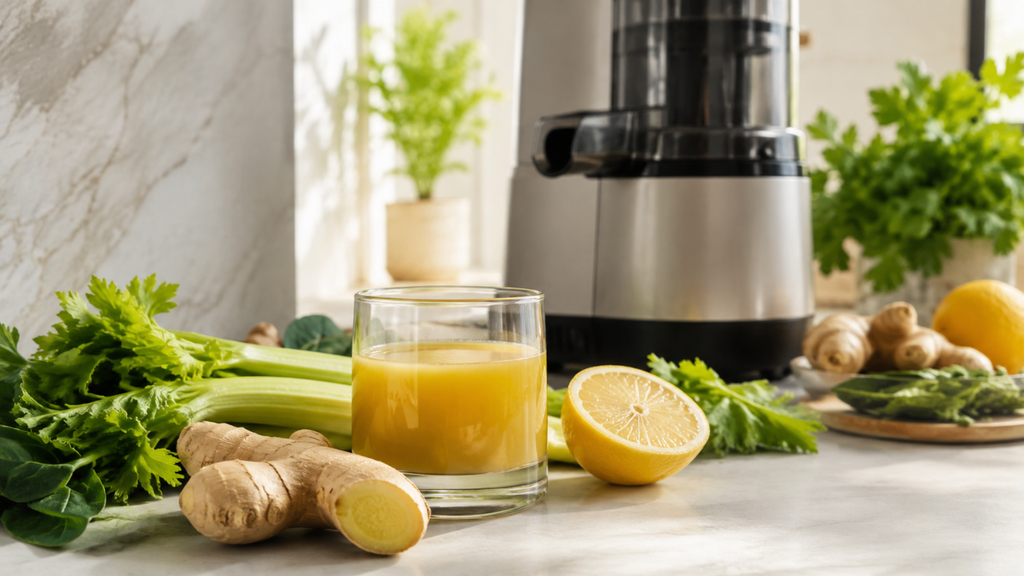
When combined with ingredients such as celery or lemon in practical juice recipes, ginger becomes a central component of digestive-focused blends. Because ginger is a dense, fibrous root, extraction method matters — using a slow juicer can improve yield while preserving its active compounds.
Ginger Juice and Healthy Blood Circulation
Although ginger does not act through the nitrate–nitric oxide pathway in the same way as beetroot juice, it supports circulation in the following ways:
Ginger has been shown to:
- Reduce platelet aggregation
- Improve peripheral blood flow
- Promote mild vasodilation
- Enhance thermogenesis
Improved circulation supports oxygen delivery to tissues and the efficient transport of nutrients and metabolic byproducts — processes that are particularly relevant during a structured body cleansing protocol.
Ginger Juice and Inflammation Modulation
Inflammation is regulated by complex cellular signalling networks. Ginger influences several of these pathways. Experimental research indicates ginger compounds may:
- Help reduce the production of inflammatory chemicals that contribute to pain and swelling
- Lower levels of inflammatory messengers in the body associated with chronic inflammation
- Support the body’s natural antioxidant defence systems
- Reduce markers of oxidative stress, which can damage cells over time
Ginger works across multiple inflammatory pathways, supporting circulation and digestion — making it particularly useful for everyday inflammatory stress. When paired with antioxidant-rich vegetables such as carrot juice, ginger can further support cellular protection and inflammatory balance:
- Digestive inflammation: Because ginger directly stimulates digestive secretions and reduces inflammatory activity in the gut lining, it can help relieve bloating and irritation.
- Exercise recovery: Ginger may help in post-exercise muscle recovery and soreness by enhancing blood circulation, and regulating inflammatory chemicals released after physical stress.
- Joint stiffness: Ginger’s ability to reduce inflammatory signalling may help decrease pain and stiffness associated with joint pain.
- Circulatory inflammation: By supporting healthy blood flow and reducing oxidative stress, ginger may help protect blood vessels from inflammatory damage.
Ginger Juice and Blood Sugar Regulation
Emerging research suggests ginger may support metabolic stability and insulin sensitivity. Mechanisms include:
- Enhanced glucose uptake in muscle cells
- Reduced oxidative stress associated with hyperglycaemia
- Improved blood sugar regulation after meals (postprandial glucose control)
Persistent low-grade inflammation is closely linked to insulin resistance. By modulating inflammatory signalling, ginger may indirectly support metabolic balance. For a deeper exploration of vegetable juices and glucose control, see our article on juicing to lower blood sugar.
Ginger Juice in a Structured Body Cleanse
Within a structured body cleanse program, ginger serves distinct roles across phases — supporting digestion, circulation and inflammatory balance as the body adjusts. When used as part of a comprehensive juice detox, these effects help create the physiological conditions necessary for deeper metabolic adaptation.
1. Gut Reset Phase
- Stimulates digestive secretions and gastric activity
- Reduces digestive sluggishness and bloating
- Supports coordinated enzyme release
2. Liver Detox Phase
- Encourages healthy bile movement
- Enhances blood flow to support nutrient transport
- Helps regulate inflammatory signalling
3. Fasting Phase
- Reduces nausea during reduced caloric intake
- Maintains healthy circulatory tone
- Helps stabilise energy levels as the body transitions to fat metabolism
These effects align naturally with the Nature Heal 3-Step System, where digestion is first supported, liver function is then optimised, and therapeutic fasting follows.
Each stage prepares the body for the next. Ginger juice is particularly relevant during a focused 3-day juice cleanse, when digestive efficiency, steady blood circulation and metabolic stability help the body adapt smoothly to reduced caloric intake.
A Historical Note: Ginger in Traditional Medicine
Ginger has been cultivated for more than 3,000 years. In Ayurvedic medicine, it is used to strengthen “agni” — the digestive fire responsible for nutrient transformation. In Traditional Chinese Medicine, ginger is classified as warming and dispersing, used to support circulation and digestive harmony.
Historically, ginger travelled along the Silk Road and became one of the most widely traded medicinal roots in the ancient world. It was often used alongside pomegranate, celery, lemon and turmeric — many of which continue to appear in modern juicing protocols.
💡For a broader context, see our guide to Juicing in Antiquity.
When Should You Be Cautious with Ginger Juice?
Ginger juice is best used in moderate amounts. However, thoughtful use is advised in the following situations:
Gastritis or Active Ulcer
Strong ginger shots may irritate inflamed stomach lining.
Gallstones
Because ginger stimulates bile flow, individuals with known gallstones should consult a professional before using regular concentrated amounts.
Blood-Thinning Medication
Ginger may have blood-thinning effects. Those taking anticoagulant medication that also use concentrated ginger regularly should seek professional advice.
Acid Sensitivity or Reflux
Small diluted amounts are usually tolerated, but large concentrated doses may aggravate symptoms. Moderation is key. Therapeutic benefits do not require excessive dosing.
Read Next
➡️ Structured Juice Cleanse: A multi-phase approach that supports digestion, circulation, and metabolic balance.
➡️ Juicing Recipes: Enhance digestion, blood circulation & improve overall nutrient utilisation.
➡️ Best Juicer: Learn how choosing the right juicer improves extraction & preserves key bioactive compounds.
➡️ Juicing to Lower Blood Sugar: Specific vegetable juicing strategies that support insulin sensitivity.
➡️ Phytonutrients: Explore how plant compounds influence inflammation, digestion & cellular protection.
➡️ 3 Day Juice Cleanse: A short-term protocol that supports digestion, blood circulation & metabolism.
➡️ Beetroot Juice, Carrot Juice, Lemon Juice, Pomegranate Juice: Understand how these complementary ingredients work alongside ginger to support circulation, antioxidant activity, and metabolic balance.

FAQs About Ginger Juice
Is ginger juice good for digestion?
Yes. Ginger stimulates gastric secretions, pancreatic enzyme output, and bile flow, supporting efficient digestion.
Should I drink ginger juice before or after meals?
For digestive activation, 15–20 minutes before meals is ideal. After meals, it may help reduce nausea or bloating.
Does ginger juice reduce inflammation?
Ginger modulates inflammatory enzymes and cytokines, contributing to reduced oxidative stress and inflammatory signalling.
Can ginger juice help blood sugar levels?
Emerging research suggests ginger may improve insulin sensitivity and glucose uptake, particularly when combined with low-sugar vegetable juices.
Is ginger juice safe every day?
Moderate daily use is generally safe for most individuals. Excessive concentrated doses are unnecessary.
How much ginger juice should I drink?
Small amounts — approximately 5–10 grams of fresh ginger juiced — are typically sufficient.
Disclaimer: This content is for informational and educational purposes only and is not intended to diagnose, treat, or cure any disease. It is not a substitute for professional medical advice. Please consult a qualified healthcare professional before making significant changes to your health regimen. This article may contain affiliate links. As an Amazon Associate, Nature Heal may earn from qualifying purchases.