💡 Heads Up: This article is approximately 1,400 words and designed as a comprehensive educational guide. You may find it helpful to bookmark this page and return to it in stages which will make it easier to understand and integrate into your health routine.
Beetroot juice is one of the most physiologically active vegetable juices available, with measurable effects on blood circulation, liver detoxification, and cellular protection. Rich in phytonutrients and naturally high in dietary nitrates, it enhances blood flow and blood vessel flexibility while supporting the body’s detoxification pathways.
Its nitric oxide–promoting compounds enhance blood circulation and improve oxygen delivery to working muscles, which is why beetroot juice is widely used by endurance athletes to support stamina and performance.
Separately, its antioxidant phytonutrients help buffer oxidative stress. During a structured juice cleanse, liver detoxification activity increases, and this can temporarily elevate oxidative load. Beetroot’s antioxidants help counter this by protecting cells from damage and helping to regulate inflammation.
For these reasons, beetroot juice is one of the most valuable ingredients in juice recipes designed to support energy, endurance, and stamina. It is particularly useful during a structured 3-day juice cleanse — where efficient circulation, active detoxification, and inflammation control become especially important.
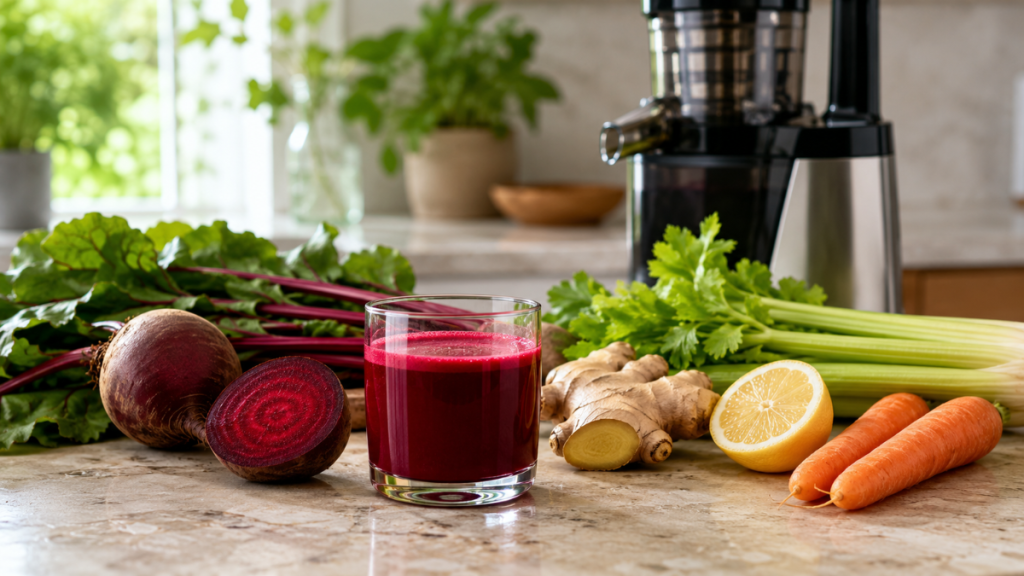
Because beetroot is dense and fibre-rich, extraction method plays a key role — using a slow juicer can improve yield while helping preserve its delicate phytonutrient profile.
Table of Contents
The Phytonutrients in Beetroot
Beetroot Juice: Blood Circulation & Blood Pressure
Beetroot Juice and Liver Detoxification
A Historical Note: Beetroot Juice in Antiquity
When Should You Be Cautious with Beetroot Juice?
The Phytonutrients in Beetroot Juice
Beetroot’s deep red-purple colour reflects its distinctive biochemical composition. The primary phytonutrients responsible for its physiological activity are betalains and naturally occurring dietary nitrates. It also provides folate and smaller amounts of polyphenolic compounds.
Betalains
Betalains are water-soluble pigments unique to beetroot and a small number of other plants. The main compounds include betanin, isobetanin, and vulgaxanthins.
Betalains function as antioxidants. They help neutralise reactive oxygen species and support cellular protection. They also support with detoxification pathways in the liver, particularly those involved in conjugation and antioxidant defence.
Dietary Nitrates
Although dietary nitrates are not phytonutrients in the strictest sense, they are one of the most biologically active compounds in beetroot.
These compounds serve as precursors to nitric oxide within the body. Nitric oxide is a signalling molecule that regulates blood vessel dilation and vascular function. By influencing nitric oxide production, dietary nitrates can improve blood circulation and oxygen delivery throughout the body. This nitrate–nitric oxide pathway is central to many of beetroot’s practical effects, discussed in the following sections.
Folate (Vitamin B9)
Folate is a vitamin rather than a phytonutrient, but it contributes meaningfully to beetroot’s overall nutritional profile. Beetroot provides meaningful levels of folate, a B vitamin involved in DNA synthesis and methylation processes. Methylation is a biochemical pathway that supports detoxification, gene regulation, and homocysteine balance. Folate contributes to these foundational metabolic processes.
If beetroot juice forms part of a regular routine, investing in the best juicer can significantly improve both juice quality and overall extraction efficiency.

Beetroot Juice: Blood Circulation & Blood Pressure
As discussed above, beetroot’s nitrates increase nitric oxide production. In practical terms, this means improved blood vessel dilation and more efficient circulation.
Nitric oxide relaxes the smooth muscle within blood vessel walls, resulting in:
- Increased vessel diameter
- Reduced vascular resistance
- Improved tissue oxygenation
This directly influences blood pressure regulation. Clinical studies have demonstrated that beetroot juice can reduce blood pressure, with measurable effects occurring within hours of consumption and sustained improvements seen with regular intake.
These vascular effects also explain beetroot juice’s popularity among endurance athletes. Improved oxygen delivery to working muscles can enhance stamina and delay fatigue. By supporting efficient blood flow, beetroot juice helps optimise performance during sustained physical effort.
During a structured juice cleanse, improved circulation may support more efficient nutrient delivery and metabolic waste removal.
Efficient blood circulation also plays a role in metabolic regulation, and vegetable juices can influence glucose handling and insulin sensitivity — explored further in our guide on juicing to lower blood sugar.
Beetroot Juice and Liver Detoxification
While nitric oxide influences circulation, beetroot’s betalain phytonutrients, outlined earlier, play a more significant role in antioxidant defence and detoxification support.
During fasting or a structured body cleanse, the liver increases activity across both Phase I and Phase II detoxification pathways. In Phase I, compounds are converted into intermediate metabolites. In Phase II, these metabolites are prepared for elimination.
Increased detoxification activity can temporarily elevate oxidative stress. Betalains help buffer this process by supporting antioxidant systems such as glutathione and reducing excessive inflammatory signalling.
Although beetroot juice is not a “liver cleanse” in isolation, it contributes to the biochemical environment required for efficient detoxification and cellular protection — particularly during therapeutic fasting or a structured 3-day juice cleanse.
A Historical Note: Beetroot Juice in Antiquity
Beets have been cultivated for more than 2,000 years. In ancient Mediterranean cultures, beet leaves were used medicinally for digestive complaints, fever, and blood-related conditions.
Although early practitioners did not understand nitric oxide or phytonutrients, they recognised that certain plants supported vitality and circulation. They also used several other fruit and vegetables, therapeutically:
- Pomegranate Juice: Widely used in ancient Persia and Greece, was valued for its effects on the blood and heart.
- Celery Juice: Used in ancient Egyptian and Roman medicine for fluid balance and inflammation.
- Ginger Juice: Documented in Ayurvedic and Chinese medicine as a digestive and circulatory stimulant.
- Lemon Juice: Prized for its cleansing and preservative properties.
These plants were observed empirically — long before biochemical pathways were understood. Modern nutritional science now explains what ancient practitioners were able to observe empirically: certain fruits and vegetables exert measurable effects on circulation, detoxification, and metabolic function.
For a broader historical context, see our article on juicing in antiquity.
When Should You Be Cautious with Beetroot Juice?
Beetroot juice is safe for most people when consumed in moderate amounts. However, because it has measurable physiological effects, it should be used thoughtfully in certain situations:
Low Blood Pressure (Hypotension)
Because beetroot increases nitric oxide and widens blood vessels, it can lower blood pressure. For individuals who already experience low blood pressure, dizziness, or who are taking antihypertensive medication, beetroot juice may amplify these effects.
Kidney Stones (Oxalates)
Beetroot contains naturally occurring oxalates. For people with a history of calcium oxalate kidney stones — high intake may increase stone risk. Occasional moderate use is usually well tolerated, but daily high-volume consumption may not be appropriate.
Beeturia
Some people notice red or pink urine after drinking beetroot juice. This harmless condition, known as beeturia, is simply the result of beet pigments passing through the digestive system and does not indicate blood in the urine.
Read More
➡️ Structured Juice Cleanse: How structured body cleansing supports detoxification, circulation & metabolism.
➡️ Juicing Recipes: Practical combinations designed for energy, liver support, blood sugar balance & endurance.
➡️ 3 Day Juice Cleanse: A guide to the fasting phase, including preparation, execution & reintroduction.
➡️ Phytonutrients: A deeper look at the plant compounds that drive antioxidant activity and cellular protection.
➡️ Pomegranate Juice, Carrot Juice, Celery Juice, Lemon Juice, and Ginger Juice: Explore how these ingredients complement beetroot in supporting circulation, digestion, and detoxification.

FAQs About Beetroot Juice
Is beetroot juice good for blood pressure?
Yes. Clinical studies show beetroot juice can reduce systolic and diastolic blood pressure due to its high nitrate content, which increases nitric oxide and promotes vasodilation.
How much beetroot juice should I drink per day?
Most studies use 70–250 ml per day. During a cleanse, beetroot is best combined with other vegetable juices rather than consumed in large concentrated amounts.
Can beetroot juice help with cholesterol?
Some studies suggest beetroot’s antioxidants may reduce LDL oxidation and support lipid metabolism, though it should not replace medical treatment for high cholesterol.
Does beetroot juice detox the liver?
Beetroot supports liver function through its betalain content and antioxidant activity, but detoxification is a complex process involving multiple pathways.
Why does beetroot juice turn urine red?
This harmless condition, called beeturia, occurs when pigments pass through the digestive system without full breakdown.
Is beetroot juice safe for kidney stones?
Beetroot contains oxalates, which may contribute to kidney stone formation in susceptible individuals. Those with a history of stones should moderate intake.
When is the best time to drink beetroot juice?
For circulation or performance, 2–3 hours before exercise is ideal. During a juice cleanse, it can be used in the morning or early afternoon.
Disclaimer: This content is for informational and educational purposes only and is not intended to diagnose, treat or cure any disease. It is not a substitute for professional medical advice. Please consult a qualified healthcare professional before making significant changes to your health regimen. This article may contain affiliate links. As an Amazon Associate, Nature Heal may earn from qualifying purchases.