This article contains around 2,500 words of valuable educational content to help improve your health and wellbeing. We recommend bookmarking this page and reading it in smaller, manageable sections. Taking your time will make it easier to absorb the information and apply it to your lifestyle effectively.
Few natural substances look quite as unremarkable as bentonite clay. Pale, powdery and formed from ancient volcanic ash, it doesn’t look particularly remarkable—but add water and this fascinating mineral transforms almost instantly, swelling into a dense paste with an unusually large, electrically charged surface.
That remarkable property explains why bentonite clay has found its way into everything from skincare and food processing to environmental clean-up. It also explains why it has remained a popular ingredient in natural health for generations, where it is traditionally used to bind certain compounds within the digestive tract before they leave the body. Its adsorption capacity is well recognised in chemistry, particularly for binding substances such as aflatoxins and certain metals under specific conditions.
Nature Heal’s guide on how to detox your body explains how gut cleansing, liver support and fasting work together within our complete three-step body cleansing system.
In This Article
Where Does Bentonite Clay Come From?
The Historic use of Bentonite Clay
Calcium vs Sodium Bentonite Clay
Bentonite Clay Benefits: What Does the Evidence Suggest?
Bentonite Clay Mask: Why Is It So Popular?
How to Make a Simple Bentonite Clay Face Mask
Bentonite Clay Side Effects and Precautions
What Is Bentonite Clay?
Bentonite is a naturally occurring clay formed from volcanic ash that has been transformed over millions of years through the action of water and geological pressure. Its principal mineral is montmorillonite, a member of the smectite clay family, which is responsible for many of bentonite’s unique physical characteristics.
Montmorillonite consists of extremely fine, layered mineral sheets. Tiny changes within this structure leave the clay with a predominantly negative electrical charge, allowing it to attract positively charged ions while presenting an exceptionally large surface area capable of interacting with certain molecules.
Two scientific terms are often confused when discussing bentonite clay:
- Absorption occurs when one material takes another into its internal structure—rather like a sponge soaking up water.
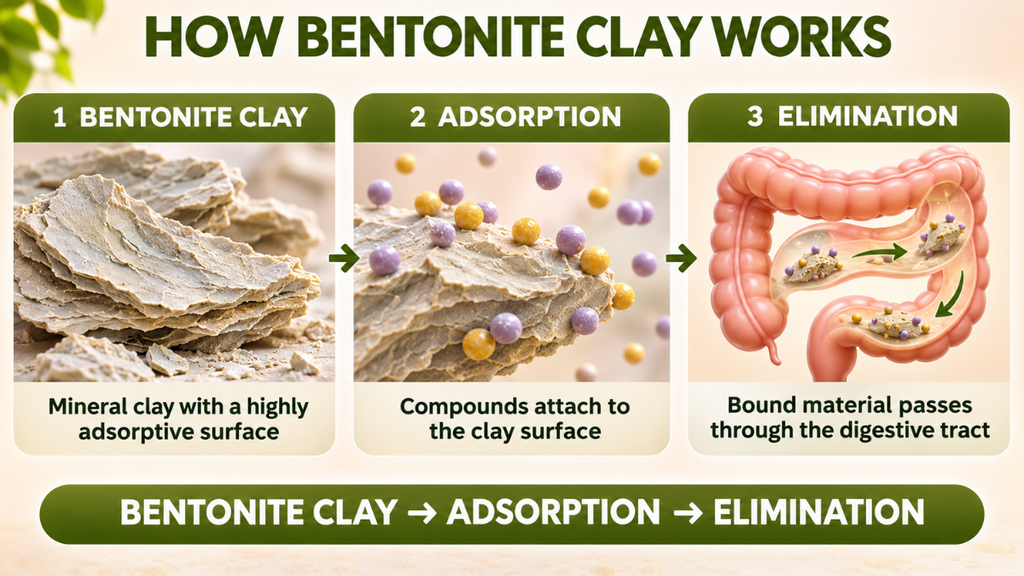
- Adsorption occurs when molecules or ions adhere to a material’s surface. Bentonite’s proposed binding action is primarily described as adsorption, together with ion exchange.
Understanding this distinction is important because bentonite doesn’t simply “soak up toxins.” Instead, its enormous surface area allows certain substances to attach to the clay before both pass through the digestive tract together.
These physical properties explain why it is frequently combined with psyllium husk, which provides soluble fibre and helps support the movement of bowel contents through the digestive tract.
Where Does Bentonite Clay Come From?
Bentonite deposits form where volcanic ash has been chemically altered by water over thousands to millions of years. The resulting clay varies according to its geological origin, surrounding minerals, the chemistry of the original volcanic ash and the environmental conditions under which it formed.
The name bentonite originates from the Benton Shale deposits of Wyoming in the United States, where the clay was first described commercially during the late nineteenth century. Today, however, bentonite is mined throughout the world, including North America, India, Turkey, Greece and other regions with suitable volcanic geology.
Its applications extend far beyond natural health. Bentonite is widely used in drilling fluids, foundry work, engineering, pharmaceuticals, cosmetics, food production, wine clarification and environmental remediation.
💡This broad industrial use highlights an important point: not every bentonite product is intended for human consumption.
The Historic Use of Bentonite Clay
For thousands of years, clay has been revered as a natural healing remedy across cultures and continents. Long before modern medicine, ancient civilisations instinctively recognised its detoxifying, mineral-rich properties – using it both internally and externally for health and healing:
- Ancient Egypt: Egyptian healers used clay for wound healing, digestive issues, and embalming. Clay tablets and papyri from over 5,000 years ago document its use in medical treatments. Egyptian queens, including Cleopatra, were said to use clay masks to maintain their legendary beauty and youthful skin.
- Greek and Roman Medicine: Hippocrates (the father of modern medicine) wrote about clay’s ability to absorb toxins and support digestive health. Roman soldiers reportedly carried clay with them to neutralise food poisoning on long military campaigns.
- Native American Tribes: Clay was considered sacred and was ingested to ease stomach discomfort, food poisoning and infections. Some tribes also used it as a natural wound dressing to prevent infection.
- Ayurvedic & Traditional Chinese Medicine (TCM): Clay was used as a cooling agent to counteract excessive heat and toxins in the body, promoting balance in the digestive and immune systems.
- Indigenous African and South American Cultures: Many tribes consumed clay as a natural binder for toxins when eating wild plants or meat that may have contained parasites or bacteria. It was also applied externally to treat skin conditions, burns and insect bites.

Calcium vs Sodium Bentonite Clay
Bentonite clay is commonly classified according to the dominant exchangeable mineral it contains. The two most common forms are calcium bentonite and sodium bentonite. Although both are rich in montmorillonite, they behave quite differently when mixed with water.
Calcium bentonite is often marketed for cosmetic products and some preparations intended for internal use, while sodium bentonite’s greater swelling capacity makes it particularly valuable in industrial applications such as sealing, drilling and engineering.
| Feature | Calcium bentonite | Sodium bentonite |
| Dominant ion | Calcium | Sodium |
| Swelling | Generally lower swelling | Generally much greater swelling |
| Texture in water | Often forms a softer, less expansive paste | Can form a highly viscous gel |
| Common uses | Cosmetics and some products marketed for internal use | Industrial binding and sealing; also used in some regulated food or feed applications |
How Does Bentonite Clay Work?
When bentonite clay is mixed with water, millions of microscopic mineral layers separate and expand, dramatically increasing the clay’s available surface area. Combined with its predominantly negative electrical charge and natural ion-exchange capacity, this gives bentonite the ability to adsorb certain substances under suitable conditions.
Adsorption in the Digestive Tract
Unlike nutrients, bentonite clay is not intended to be absorbed into the bloodstream. Instead, its proposed action remains local within the digestive tract, where the clay passes through the bowel while interacting with certain compounds before both are eliminated naturally in the stool.
This is an important distinction. Binding depends on many variables, including pH, particle size, hydration, competing substances and the specific compound being studied.
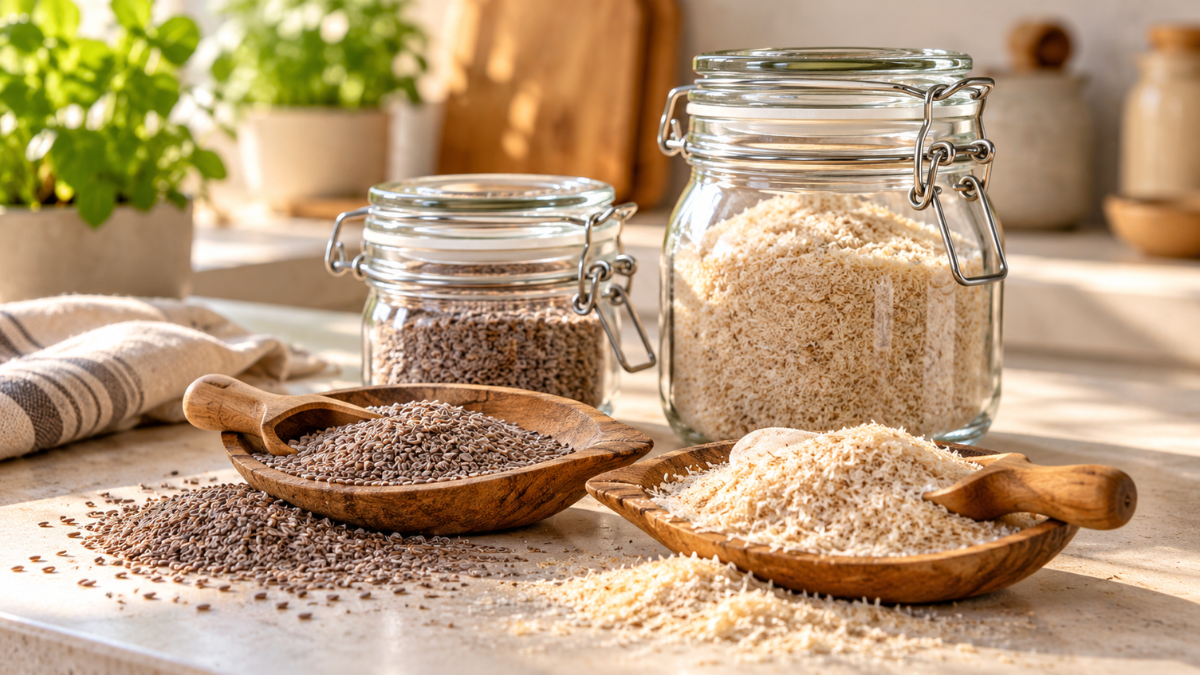
At Nature Heal, bentonite clay and psyllium husk form the first stage of our structured gut cleansing programme. Bentonite provides the adsorptive mineral surface, while psyllium husk is a rich source of soluble fibre that contributes bulk and helps support normal bowel movements.
💡 Once the gut cleanse phase is complete, the next step is to support the liver—our guide on how to detox the liver explains why this is such an important part of the body’s natural cleansing process.
Heavy Metals and Environmental Compounds
Scientific research has shown that specially characterised montmorillonite clays can adsorb certain metals and environmental toxins under experimental conditions. One of the best-studied examples is the binding of aflatoxins, while laboratory studies have also investigated interactions with substances such as lead, mercury, cadmium and arsenic.
Although these findings are scientifically interesting, they should not be interpreted as proof that ordinary retail bentonite products can treat heavy-metal poisoning. Natural clay itself originates from the earth and may contain trace metals unless it has been appropriately purified and independently tested.
Bentonite Clay Benefits: What Does the Evidence Suggest?
Bentonite clay has been used for centuries in traditional health practices and continues to attract scientific interest today. However, not every claimed benefit is supported by the same level of scientific evidence:
1. Binding Certain Compounds in the Digestive Tract
Bentonite clay’s most distinctive property is its ability to adsorb certain molecules onto its surface. Carefully characterised clays have demonstrated this ability under laboratory conditions, particularly when binding substances such as aflatoxins. This provides a sound scientific basis for investigating bentonite as a gastrointestinal binder.
If you’re interested in how the body’s natural detoxification systems work together, our guide to how to detox the body explores this process in more detail.
Healthy digestion also depends on the coordinated function of the liver and gallbladder. If you’d like to understand how bile supports fat digestion and why gallbladder health matters, our guide to what a gallbladder cleanse is explains the gallbladder’s role in healthy digestion.
2. Supporting Digestive Wellness
Because bentonite clay absorbs water and presents a large reactive surface, it has traditionally been used as part of various digestive wellness practices. A common practice is to combine bentonite clay with psyllium husk — a soluble fibre that contributes bulk and supports normal bowel movements. Bentonite provides the adsorptive clay surface, while psyllium helps move material through the digestive tract.
Whichever approach is taken, adequate hydration remains essential. Both clay and soluble fibre absorb water, and insufficient fluid intake may increase the likelihood of constipation rather than supporting comfortable bowel function.
Within natural health, several traditional approaches are used to support digestive cleansing. Bentonite clay works through adsorption, whereas a salt water cleanse relies on a temporary flushing action within the bowel. Although the two methods are sometimes discussed together, they work in very different ways and are generally performed separately.
Many people choose to complete a body cleanse from home, allowing them to follow a step-by-step programme at their own pace while building healthy habits that support long-term wellbeing.
3. Skin Cleansing and Oil Absorption
Beyond its internal applications, bentonite clay has become one of the world’s most popular natural skincare ingredients. Its ability to absorb water and excess oil makes it a common ingredient in facial masks, scalp treatments and cleansing products.
Many people also combine natural skincare with dietary approaches that support overall wellbeing, including fresh juices and periods of fasting. Our comparison of a Juice fast vs water fast explores two of the most popular approaches.
Bentonite clay may help remove surface oil and impurities, although clinical evidence supporting its use for conditions such as acne, eczema or rosacea remains limited.
Few natural ingredients have stood the test of time quite like bentonite clay. Used for generations in traditional health practices and still widely used today, its remarkable physical properties have earned the attention of both natural health practitioners and modern scientists. Although some of its proposed benefits require further clinical investigation, its unique adsorption properties are well established and continue to underpin research into its potential applications.
Bentonite Clay Mask: Why Is It So Popular?
For many people, a bentonite clay face mask provides their first introduction to this remarkable natural clay.Products such as the widely recognised Aztec Secret Indian Healing Clay have helped make bentonite one of the most searched-for skincare ingredients in the world. Mixed with water, the fine powder transforms into a smooth paste that gradually dries on the skin before being rinsed away.
Its popularity is easy to understand. Bentonite’s ability to absorb excess oil and moisture can leave the skin feeling noticeably cleaner, fresher and less greasy after use. For people with oily complexions, it has become a simple and inexpensive addition to their skincare routine.
Some people apply cold pressed castor oil after a bentonite clay mask as part of a simple natural skincare routine, particularly if the skin tends to be dry.
How to Make a Simple Bentonite Clay Face Mask
Making a bentonite clay face mask at home is straightforward, provided you choose a cosmetic-grade product and follow the manufacturer’s instructions.
- Mix a small amount of bentonite clay with clean water until it forms a smooth, spreadable paste.
- Apply a thin, even layer to freshly cleansed skin, avoiding the eyes, lips and any broken or inflamed areas.
- Leave the mask on for the length of time recommended by the manufacturer. It does not need to dry until it becomes painfully tight or begins to crack.
- Rinse thoroughly with lukewarm water before applying a gentle moisturiser if needed.
Although many online recipes recommend mixing bentonite clay with apple cider vinegar, this may increase skin irritation for some people because of its acidity.
As with any skincare product, perform a small patch test before applying the mask more widely, particularly if you have sensitive or reactive skin. Avoid using bentonite clay masks on the same day as strong exfoliating acids, retinoids or other potentially irritating treatments.
Bentonite Clay Side Effects and Precautions
Possible problems include:
- Constipation, particularly if taken without adequate water.
- Temporary bloating, abdominal discomfort or nausea.
- Reduced absorption of certain medicines or dietary supplements if taken at the same time.
- Skin dryness in some individuals when used as a face mask, particularly those with dry or sensitive skin.
💡Avoid taking bentonite clay internally during pregnancy or breastfeeding, or if you have a history of bowel obstruction, swallowing difficulties or severe constipation. If you have kidney disease, inflammatory bowel disease or take prescription medication, seek advice from your healthcare professional before use.
Conclusion
Bentonite clay has earned its place in traditional natural health through a combination of history, unique physical properties and continued scientific interest.
If you’re ready to put these principles into practice, our guide to completing a full body detox at home explains how bentonite clay can form part of a structured natural cleansing programme alongside other traditional wellness practices.
Read Next
➡️ How to Detox Your Body: Discover Nature Heal’s three-step approach to body cleansing.
➡️ Do a Full Body Cleanse at Home: Learn how to complete a structured full body cleanse from home.
➡️ Organic Castor Oil: Explore the traditional uses, potential benefits and practical applications.
➡️ Salt Water Flush: Find out how a salt water cleanse works, its traditional use and benefits.
➡️ How to Detox Your Liver: Learn why a liver detox always come after a gut cleanse.
➡️ Juice Fasting vs Water Fasting: Compare both fasting methods and discover which approach is best for you.
Bentonite Clay FAQs
Is Bentonite Clay Safe?
When used correctly, bentonite clay is generally well tolerated by most healthy adults. If you’re taking it internally, choose a product that is specifically intended for internal use, follow the manufacturer’s instructions and drink plenty of water.
If you’re pregnant, breastfeeding, have an underlying medical condition or take prescription medication, speak to your healthcare professional before using bentonite clay.
Can I Take Bentonite Clay Every Day?
Bentonite clay is traditionally used as part of a short-term wellness routine rather than as a daily supplement for life. While some people choose to use it regularly, there is limited research on long-term daily use. Following the manufacturer’s guidance and taking occasional breaks is the more sensible approach.
Is Calcium Bentonite Better Than Sodium Bentonite?
Not necessarily. Both are forms of bentonite clay, but they behave slightly differently when mixed with water. Calcium bentonite is commonly found in skincare and wellness products, while sodium bentonite is widely used in industrial applications because it swells more readily.
Does Bentonite Clay Remove Minerals from the Body?
Bentonite clay can bind certain substances within the digestive tract, but claims that it strips the body of all its essential minerals are an oversimplification. As a precaution, it’s sensible to take bentonite clay separately from medicines and dietary supplements to reduce the possibility of unwanted interactions.
Does Bentonite Clay Remove Heavy Metals?
Research has shown that certain bentonite clays can bind some heavy metals under laboratory conditions, and this remains an active area of scientific research. However, that doesn’t mean bentonite clay should be viewed as a treatment for heavy metal poisoning. If you believe you’ve been exposed to harmful levels of heavy metals, seek appropriate medical advice.
Can Bentonite Clay Be Used on Hair?
Yes. Bentonite clay is commonly used in clarifying hair and scalp masks because it helps absorb excess oil and remove product build-up. Follow the manufacturer’s instructions, rinse thoroughly after use and discontinue use if irritation occurs.
Disclaimer: This content is for informational and educational purposes only and is not intended to diagnose, treat or cure any disease. It is not a substitute for professional medical advice. Please consult a qualified healthcare professional before making significant changes to your health regimen.